Quick answer: Go up by three to five centimetres in diameter from the current pot, and no more. A big jump surrounds a small root ball with wet compost the roots cannot reach, which stays soggy and causes rot. For a cover pot rather than a repot, one to two centimetres is enough.
The single most common mistake I saw at the nursery was somebody buying a beautiful big pot for a small plant, out of kindness.
It is the opposite of kind. Let me explain why, and then give you the numbers.
The rule
Three to five centimetres wider than the pot the plant is in now. That is it.
For a small houseplant, three. For something in a 20cm pot or bigger, five. For a genuinely large specimen you can go to seven or eight, but not more.
If you would rather not do the arithmetic, our pot size calculator asks what you have and tells you what to buy.
Why bigger is worse, not better
Roots only drink from compost they are actually touching.
Put a small root ball in a huge pot and you have a wide ring of compost with no roots in it. You water; that outer compost soaks up water and holds it. Nothing draws it out. It stays wet for days, then weeks.
Wet, airless compost against a root ball is exactly the condition that causes rot — the same problem as a pot with no drainage, arrived at from a different direction.
There is a second cost. Many plants put energy into filling a pot with roots before they push out new top growth. Give them too much room and you wait longer for the plant you actually wanted.
Measure the right thing
Pot sizes are quoted as the diameter across the top, inside rim to inside rim. Not the height, not the base, not the outside.
Check that before ordering, because a "20cm pot" that is 20cm at the base and 26cm at the rim is a different object from what you expected.
Depth matters too, and separately. A shallow, wide pot suits succulents and anything with surface roots. A deep one suits plants with a taproot — a good reason to read the sizing and repotting guide before a big purchase.
Cover pot, not repot
Different job, different number.
If the plant is staying in its nursery pot and you just want something nicer around it, you need one to two centimetres of clearance, no more. Any bigger and the inner pot rattles about and tips.
Measure the nursery pot's rim, add a couple of centimetres, and look for that. Most of our decorative pots get used this way, and a set of nursery pots makes swapping easy.
How often to go up
Most houseplants want moving every eighteen months to two years. Fast growers annually. Slow ones, cacti and succulents included, can go three or four years quite happily.
The plant will tell you. Roots out of the drainage hole, water running straight through, growth stalled in spring — those mean it is ready.
Some plants actively prefer being snug. Orchids, spider plants and peace lilies all flower better slightly tight, which is why orchid pots stay small.
A worked example
A monstera in a 17cm nursery pot goes into a 21cm pot. Not a 30cm one, however good the 30cm one looks.
Two years later it goes to about 26cm, and so on. Steady steps beat one dramatic one every time. There is more specific advice in the plant-by-plant guide.
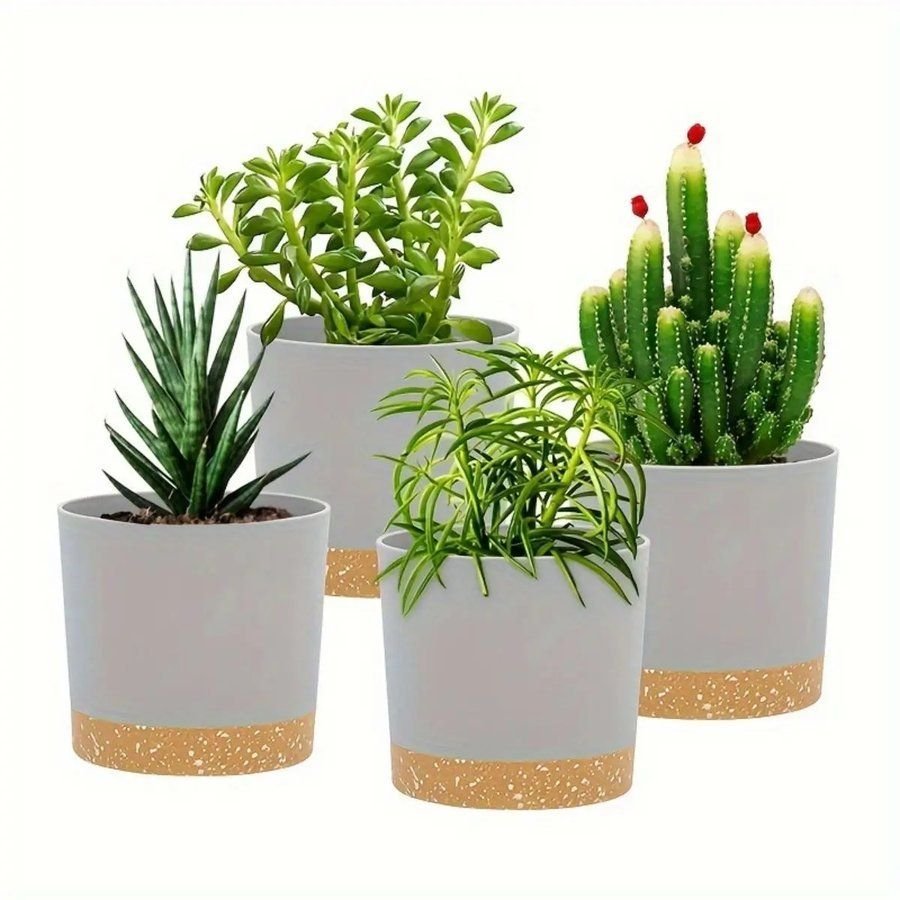
Small plants live in small pots, and something like a set of four covers a windowsill's worth of them. When you do genuinely need to go big, large indoor pots is the place, and the buyer's guide covers the rest.
The short version
- Go up three to five centimetres in diameter when repotting, and no further.
- An oversized pot leaves wet compost no root can reach, which rots the plant slowly.
- Pot size means the diameter across the inside of the rim, not the height or the base.
- For a cover pot rather than a repot, one to two centimetres of clearance is enough.
- Orchids, spider plants and peace lilies all flower better kept slightly snug.
Frequently asked questions
How much bigger should a new pot be?
Three to five centimetres wider in diameter than the current one. Three for a small houseplant, five for anything already in a 20cm pot or larger. Only go to seven or eight centimetres for a genuinely big specimen.
Why is too big a pot bad for a plant?
Roots only take water from compost they touch. A small root ball in a large pot leaves a wide ring of compost that stays saturated for weeks because nothing is drinking from it, and that wet airless zone is what causes root rot.
How is plant pot size measured?
By the diameter across the inside of the rim, not the height and not the base. It matters, because a tapered pot can measure 20cm at the base and 26cm at the top, which is a very different object from the one you pictured.
How often should I move a plant up a pot size?
Most houseplants every eighteen months to two years, fast growers annually, and cacti or succulents every three to four years. Roots emerging from the drainage hole, water running straight through, or stalled spring growth all mean it is time.
Do any plants prefer a small pot?
Yes. Orchids, spider plants and peace lilies all flower more reliably when kept slightly tight, and many succulents do better snug than roomy. Being root bound is not automatically a problem to solve.